
74% to 19%: How One BMW Dealership Solved Its Sales Turnover Problem
Market:Midwest BMW Franchise
Store Type: Single-Point BMW Dealership
Engagement:Benchmark Assessment + Fractional Dealer Advisor
Timeline:12-Month Engagement
High sales staff turnover is one of the most expensive and widely accepted problems in automotive retail. Most dealers treat it as a fact of life — rotating through new hires, absorbing the recruiting costs, and moving on. But at a single-point BMW franchise in the Midwest, the revolving door had reached a point where it was actively eroding revenue, customer satisfaction, and the store's ability to grow.
When the Dealer Principal engaged Dealer Benchmark, the store's annual sales staff turnover rate was 74% — nearly eight points above the industry average and well above the luxury segment benchmark of around 58%. The cost wasn't just measurable in dollars. It was visible in the CSI scores, in the CRM data, and in the daily grind of managers spending more time onboarding people than actually running the floor.
What followed was a 12-month engagement that touched every corner of the sales operation — and produced results across every metric that matters.
The Problem: A Store Stuck in a Constant Cycle
Before any solutions could be built, the picture had to be understood clearly. Here is where the store stood at the start of the engagement:
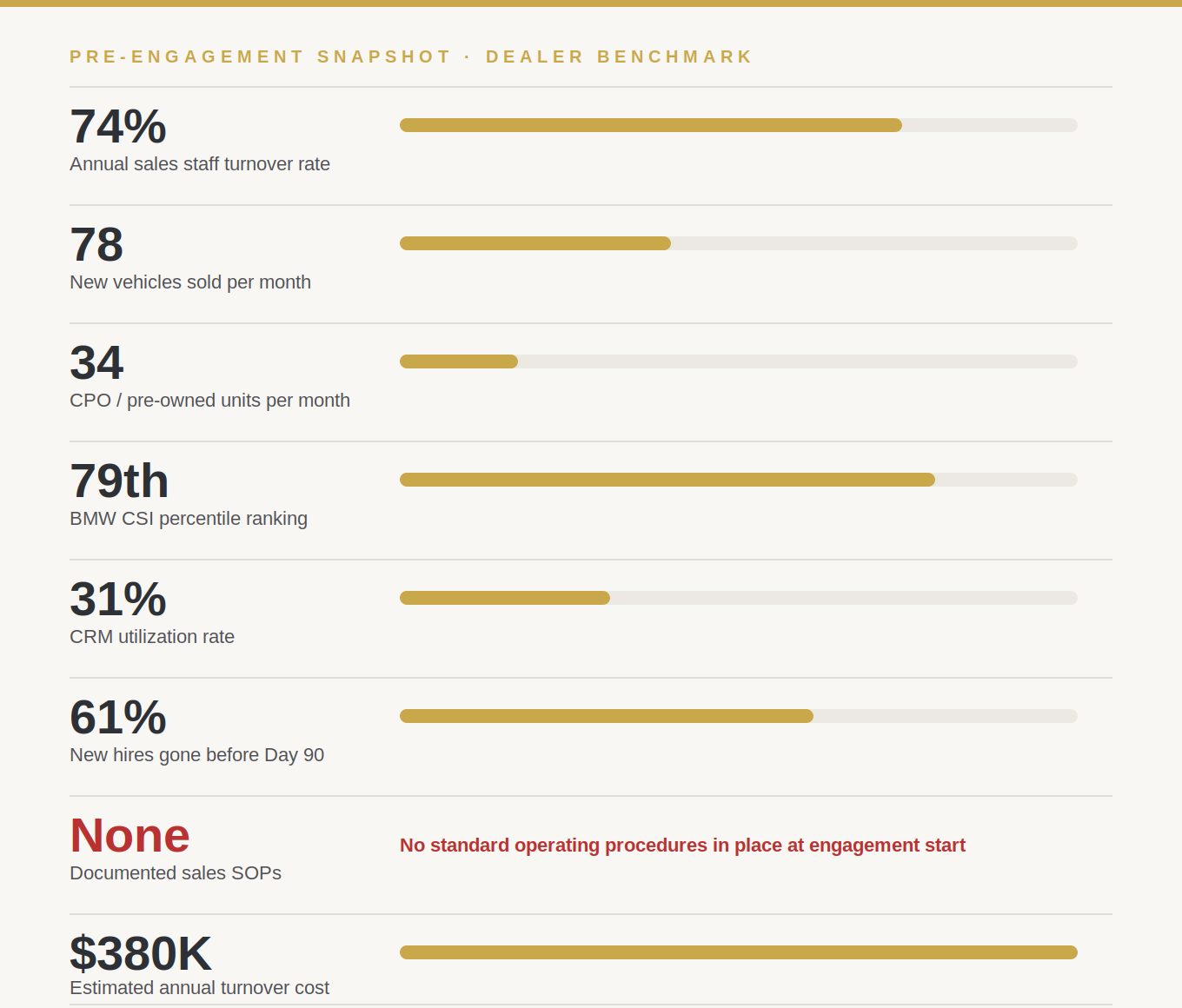
The most damaging number wasn't the turnover rate itself — it was the 61% early exit rate. More than half of all new hires were leaving before completing their first 90 days. That means the store was spending money to recruit and onboard people who never reached proficiency, never contributed meaningfully to gross, and never delivered the consistent guest experience BMW expects from its franchise partners.
Management was spending an estimated 12–15 hours per week per new hire on ad hoc training — time pulled directly from desk management, deal closing, and floor supervision. The cost of that lost focus compounded with every hire cycle.
What We Found: A Process Problem, Not a People Problem
Dealer Benchmark's engagement began with a full Benchmark Assessment — a floor-up evaluation of the store's people, processes, and systems. Over four weeks, every operational layer was examined: floor ride-alongs with sales staff, desk operation reviews, CRM activity log analysis, deal jacket data, manager interviews at every level, and benchmarking against both BMW national performance standards and regional competitors.
The central finding was clear: this was not a people problem. It was a process problem.
There were no documented sales processes. Onboarding was entirely manager-dependent — meaning every new hire's experience varied based on who happened to be working with them that week. There was no 30/60/90-day track, no structured F&I hand-off process, no defined CRM accountability standard, and no interview criteria that filtered for the right type of candidate.
Employees weren't failing. They were being set up to fail. The store was hiring into chaos, and the people who left weren't necessarily the wrong people — they were people who had no real chance to succeed.
The Engagement: Four Phases, One Clear Direction
With the assessment complete, Dealer Benchmark moved into an active Fractional Dealer Advisor engagement. The work was structured into four phases, each with defined deliverables and built-in accountability.
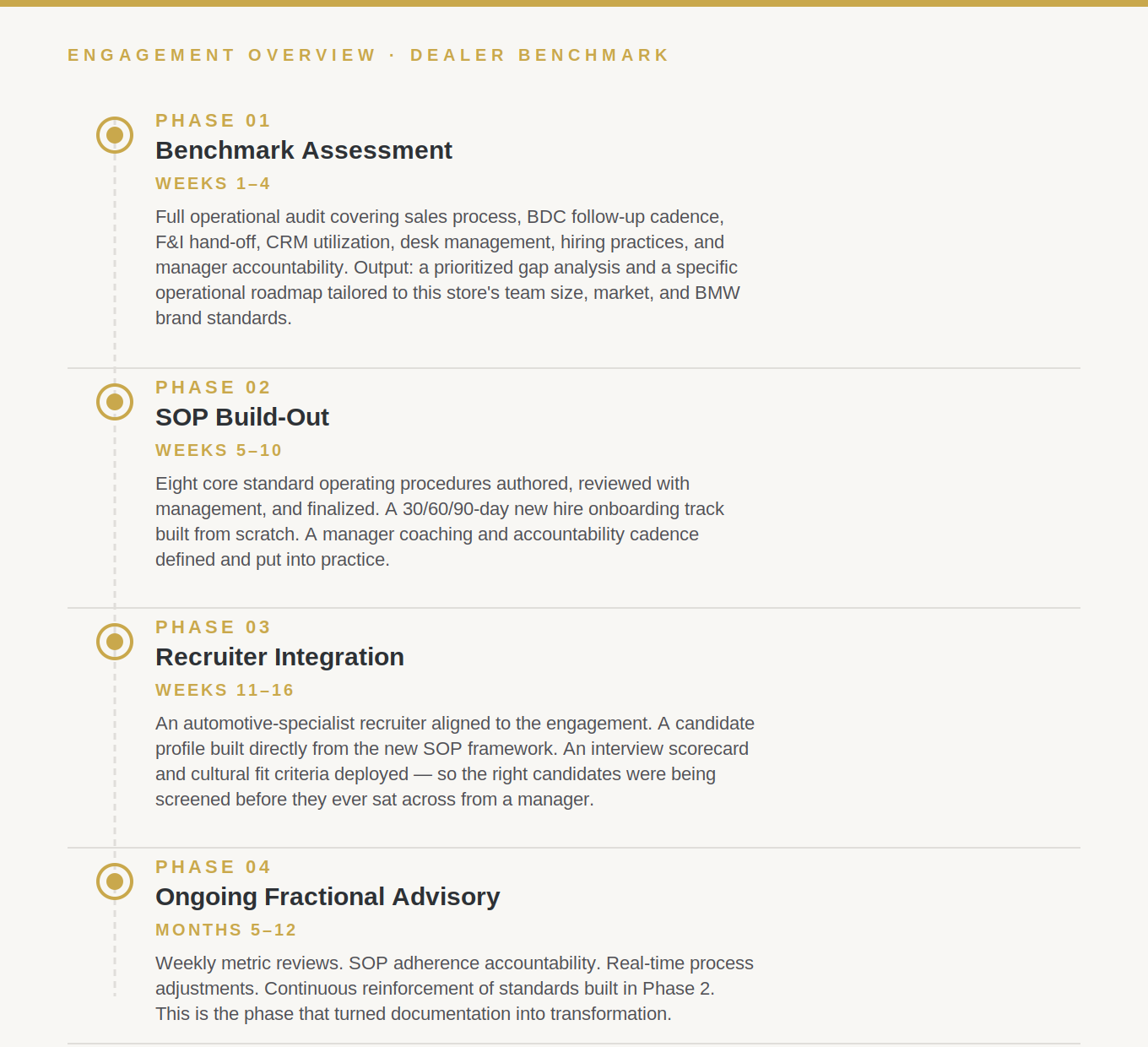
Engagement Overview - Dealer Benchmark
Building the Operational Foundation
The eight SOPs built during Phase 2 were not generic templates. They were built specifically for this store — its floor count, its team, its brand standards, and its market. Each one was walked through in structured group sessions with the sales team and reinforced individually during weekly advisory calls with management.
The eight SOPs deployed:
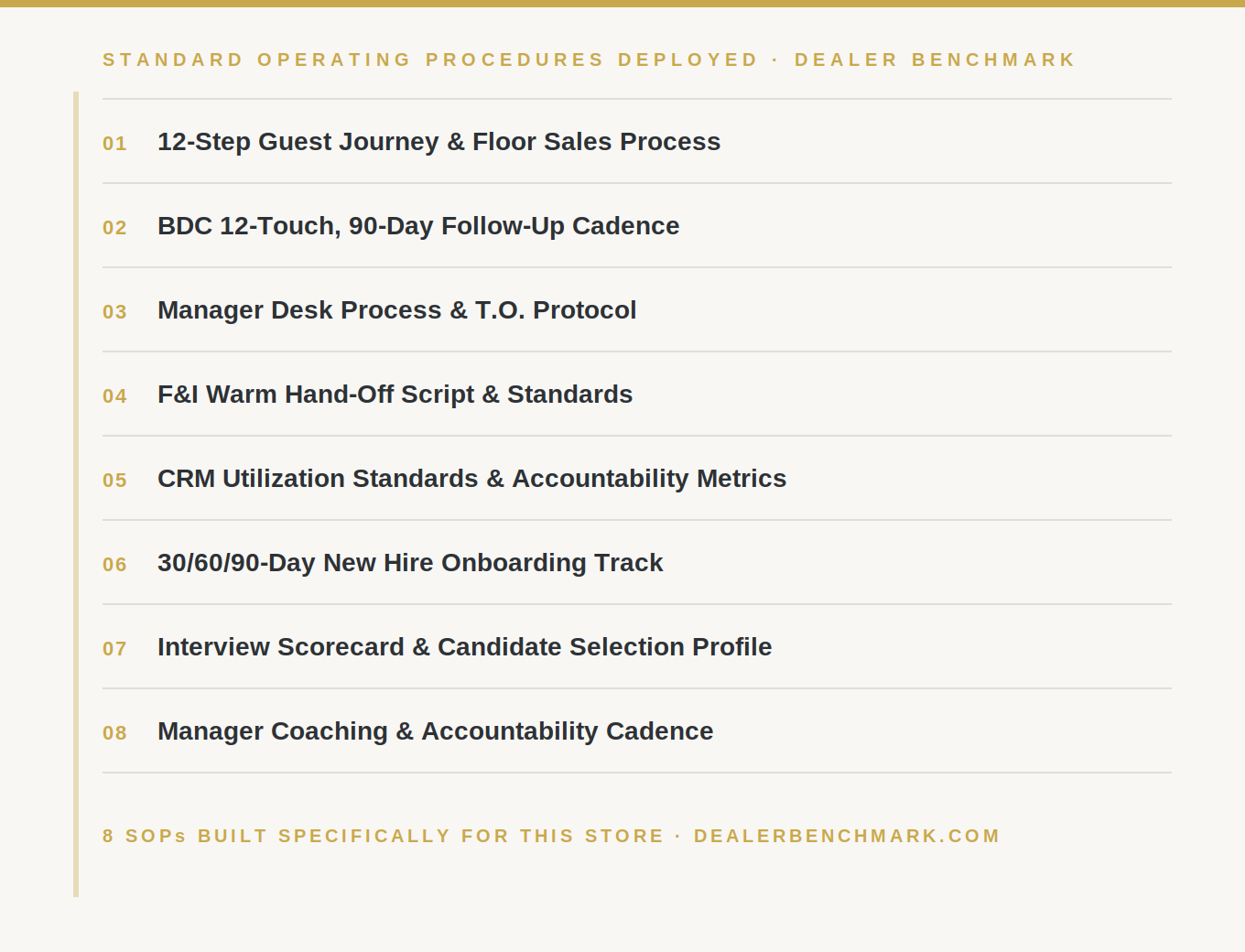
The 30/60/90-day onboarding track was particularly high-impact. New hires had a defined learning path with milestone checkpoints, reducing manager ad hoc training time by an estimated 67% and cutting time-to-productivity from 90+ days to a measured 45 days.
The Missing Piece: Getting the Right People in the Door
A better process helps the people you have. But the store also needed a better pipeline of candidates built to fit the new operational culture. Process alone doesn't fix a hiring problem — you have to align how you recruit with the environment you've built.
Dealer Benchmark connected the store with a recruiter specializing exclusively in automotive retail — not a generalist HR agency. Together, a candidate profile was built directly from the SOP framework. Candidates who demonstrated coachability, process orientation, and cultural alignment with the BMW brand experience were prioritized over candidates with high volume history from lower-tier operations.
The result was a fundamentally different type of hire entering the store — one placed into a structured environment with the tools and training to succeed from Day 1.
Three net new hires were placed in the first 90 days under the new system. All three were still employed at the nine-month mark. Average time to first closed deal: 45 days, down from 90+.
A secondary benefit emerged quickly: the structured SOP environment became a competitive recruiting advantage. Candidates who wanted a professional, process-driven operation were drawn to this store over competitors running disorganized floors. The process created the culture — and the culture started attracting better people.
"We've had consultants before. They hand you a binder and disappear. Dealer Benchmark was part of our operations every week — reviewing numbers, holding managers accountable, and adjusting the process in real time. The SOPs were the foundation, but the ongoing advisory is what made them stick."
— Dealer Principal, Midwest BMW Franchise
The Results: 12 Months. Every Metric Moved.
At the conclusion of the 12-month engagement, Dealer Benchmark conducted a full post-assessment review against the pre-engagement baseline. The data reflected a fundamentally different operation.
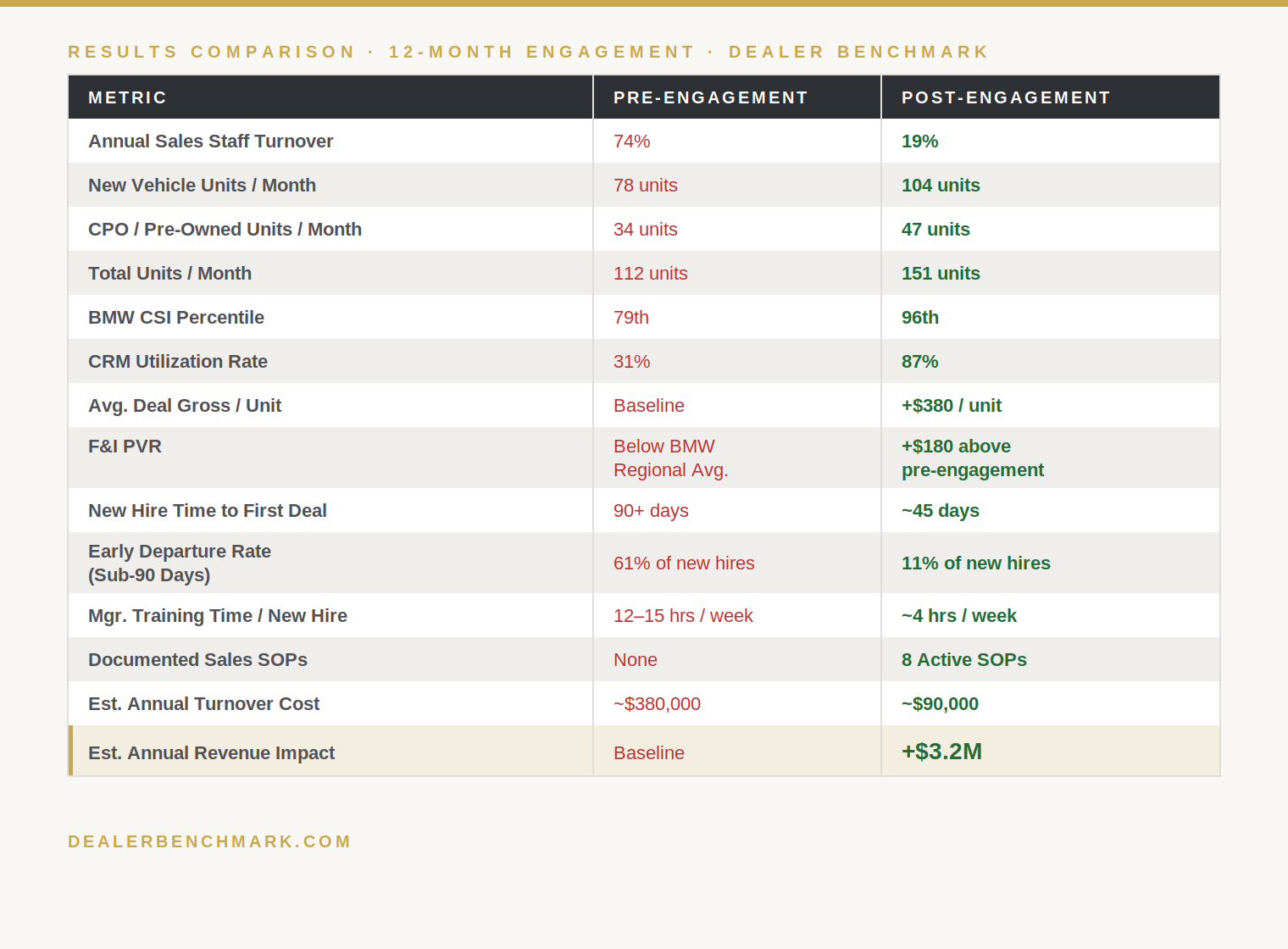
Results Comparison - Dealer Benchmark
The estimated annual revenue impact of $3.2 million was derived from volume increases across new and pre-owned, per-unit gross improvement, F&I PVR lift, and $290,000 in annual turnover cost reduction. These aren't projections — they are the measured output of a tenured sales team executing a consistent process.
What This Proves
Turnover is a process problem — not a people problem.
The instinct in automotive retail is to hire faster, pay more, and blame the candidates. This engagement proved the root cause is almost always upstream — in the absence of structure that gives good people a legitimate chance to succeed. Fix the process first.
Retention drives revenue.
A tenured sales team executing consistent process closes more deals, delivers higher gross, produces better CSI scores, and hands off to F&I with intention. Every revenue metric in this engagement improved as a direct output of retention — not as a separate initiative.
Hiring and process must align.
The right recruiter with a profile built from the SOP framework sourced a different caliber of hire. The structured environment became the recruiting pitch. Process creates culture — and culture attracts the people who will thrive in it.
Accountability is the multiplier.
SOPs without ongoing accountability are just paper. The Fractional Advisor model kept management focused on adherence, reviewed metrics weekly, and adjusted the approach in real time. That continuity is what separates a document from a transformation.
Frequently Asked Questions
What causes high sales staff turnover at car dealerships?
High sales staff turnover is most commonly caused by the absence of documented standard operating procedures, inconsistent onboarding, and no defined path to success for new hires. In most cases, turnover is a process problem — not a people problem. Without structure, even motivated employees leave before they ever have a legitimate chance to perform.
How can a dealership reduce sales staff turnover?
Dealerships can reduce turnover by implementing documented sales SOPs, building a structured 30/60/90-day onboarding track, establishing CRM accountability standards, and partnering with an automotive-specialist recruiter who screens for coachability and cultural fit — not just volume history. When process and hiring are aligned, retention improves significantly.
What is the average sales staff turnover rate at car dealerships?
The automotive retail industry averages approximately 67% annual sales staff turnover according to NADA data. Luxury franchise dealerships typically average around 58% annually. Stores operating above these benchmarks are incurring avoidable costs across recruiting, training, and lost gross profit on every departure.
How much does high dealership turnover actually cost a store?
For a single-point franchise, total annual turnover costs can easily reach $300,000–$400,000 when accounting for recruiting fees, lost gross profit, manager training time of 12–15 hours per week per new hire, CRM data gaps, and reduced CSI performance from inconsistent guest experience.
What is a Benchmark Assessment for a car dealership?
A Benchmark Assessment is Dealer Benchmark's diagnostic engagement — a full floor-up evaluation of a dealership's sales process, BDC, F&I, CRM, desk management, hiring practices, and manager accountability. The output is a prioritized gap analysis and a specific operational roadmap built around that store's team and market.
What does a Fractional Dealer Advisor do?
A Fractional Dealer Advisor provides ongoing strategic direction, accountability, and training reinforcement to a dealership's management team on a retainer basis — including weekly metric reviews, SOP adherence accountability, real-time process adjustments, and direct support for sales and management training continuity.
Your Store's Benchmark Starts Here.
Whether you're battling turnover, underperforming volume, or processes that exist only in someone's head — clarity starts with a Benchmark Assessment. Dealer Benchmark works with franchised dealerships, independent used car operations, and dealer groups across the Southwest.
Visit DealerBenchmark.com to schedule your assessment.
* Client identity has been anonymized to protect confidentiality. All performance figures represent actual results from this engagement. Industry benchmarks referenced from NADA 20 Group data, Cox Automotive Dealership Staffing Study, and BMW of North America performance reporting. Individual results will vary by market, store size, and engagement scope.
